

What are we doing?
The dream of the nineties is dead (Demna tried anyway though).

For a while, I was surrounded by “West Elm girlies.” Those who would leave the office at promptly 5:30PM for Pilates: subtle lash lift, Oura ring pulsing, pristine Alo yoga pants, Bala bangles in nondescript tote bags, gracefully gliding onto the L. After their reformer pilates session, they’d wash themselves under the soft drip of their tasteful rainfall shower head before their 9PM reservations at Via Carota.
I was not this type of girl, but I admire the hell out of her. She’s not immune to the Shopify-direct-to-consumer-industrial-complex’s propaganda; she’s been known to sleep on a Casper mattress, wash her Sweetgreen salad down with a poppi, restlessly refresh the reservations page to snag a table at Carbone (even after it lost its star). She doesn’t care if you think her Vejas or her beachy blowout is corny. She’s not above it and she doesn’t pretend to be, which is precisely why I fuck with her.
At the same time, I was also surrounded by performative cigarette-smoking art school graduates halfway between “living in a punk house” and “reluctantly accepting a corporate job.” The girl who scoffs, “I guess we can go to Mansions” before taking a too-fast drag of a Marlboro Red, her forearm mermaid tattoo serving as an eternal voyeur.
I was never this type of girl either, and frankly I’m put off by the intellectual dishonesty of this kind of put-on “above it all” posture. These two women appear to be opposites. One is polished and optimized to a fault, the other intentionally disheveled in a radical act of willful anti-optimization. They both represent different sides of the same coin: modern identity as a curation project. Both are deeply aware of themselves, of how they appear, of the cultural signals they’re sending. As the zoomers like to say, “performative,” but in different ways.
This is, of course, natural. We know too much now, about the world, about ourselves, about the aesthetics and aspirations of other people’s lives. Every so often, a video of a high school in the 1990s goes viral for how hot, happy, and weightless everyone seems to be. The people in those videos don’t look extraordinary by modern standards. Their hair brittle from years of chunky highlights, their Bonnie Bell lip gloss chunky, and their white creamy eyeshadow uneven. Their bodies were less “sculpted” than “formed.” And yet, something about them feels unattainable and impossible to reproduce now, though it’s what we all seem to really want.
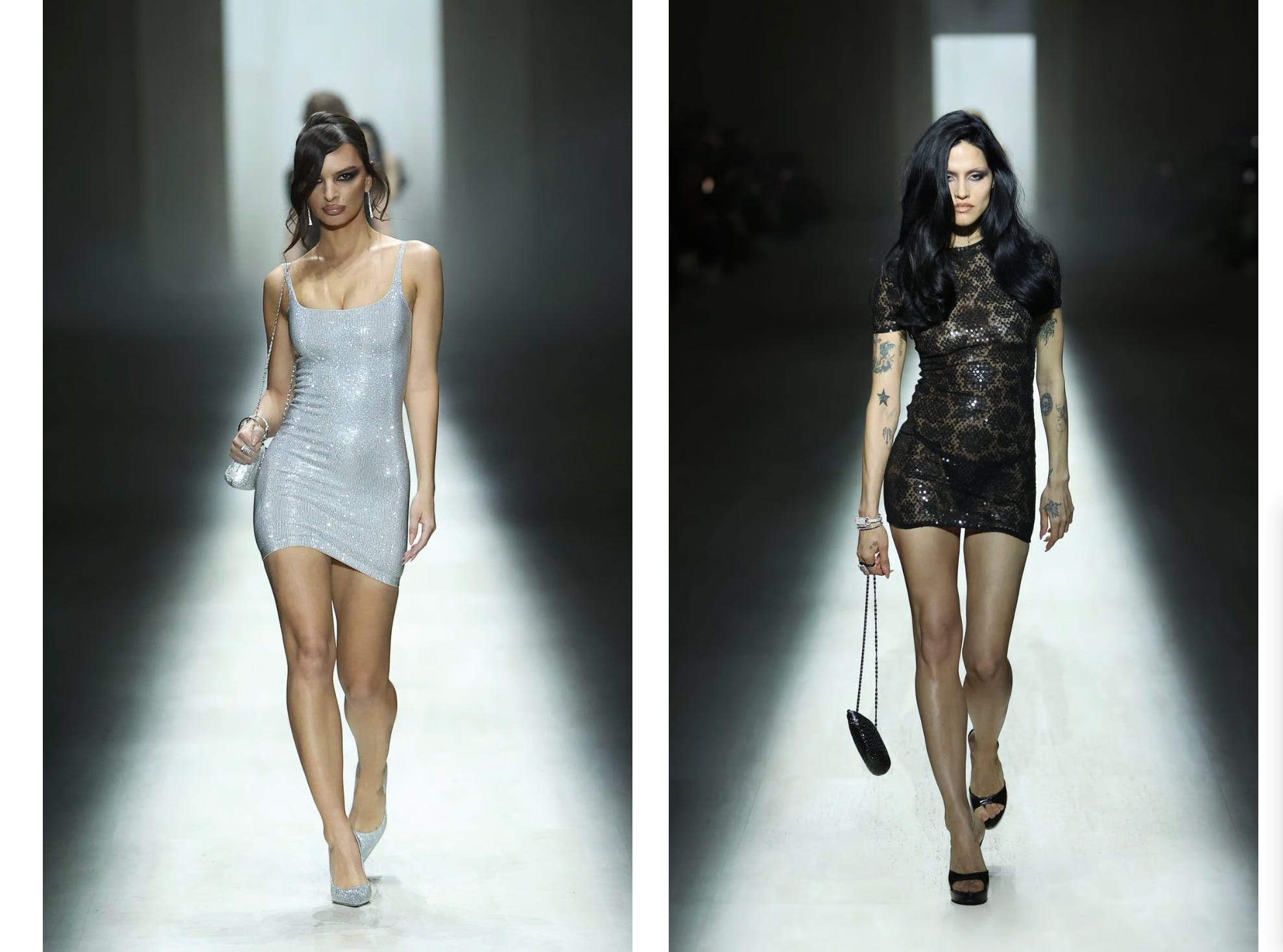
One thing that struck me about Paris fashion week last month is how even designers are yearning to bask in that happy-go-lucky, lackadaisical 90’s glow, using their fashion houses to recreate it to the delight of their patrons. In particular, Demna’s Gucci debut sometimes felt like it was reaching for that sticky, messy 1990s tabloid romance—the slick hair, the narrow silhouettes, the languid and heavy-lidded “maybe I’ll let you touch it” glamour of Tom Ford’s legacy—but it falls short. This is not because the clothes weren’t right, but because something about the runway was off-putting and uncanny. His styling was perfect, the reference points unmistakable, and yet the resemblance collapsed into some kind of body horror the moment you looked at the faces.
The problem isn’t that Demna—or any major designer—misunderstands the 90s, or why we’re all obsessed with it again. The problem is that, inside and out, the people wearing the clothes have changed.
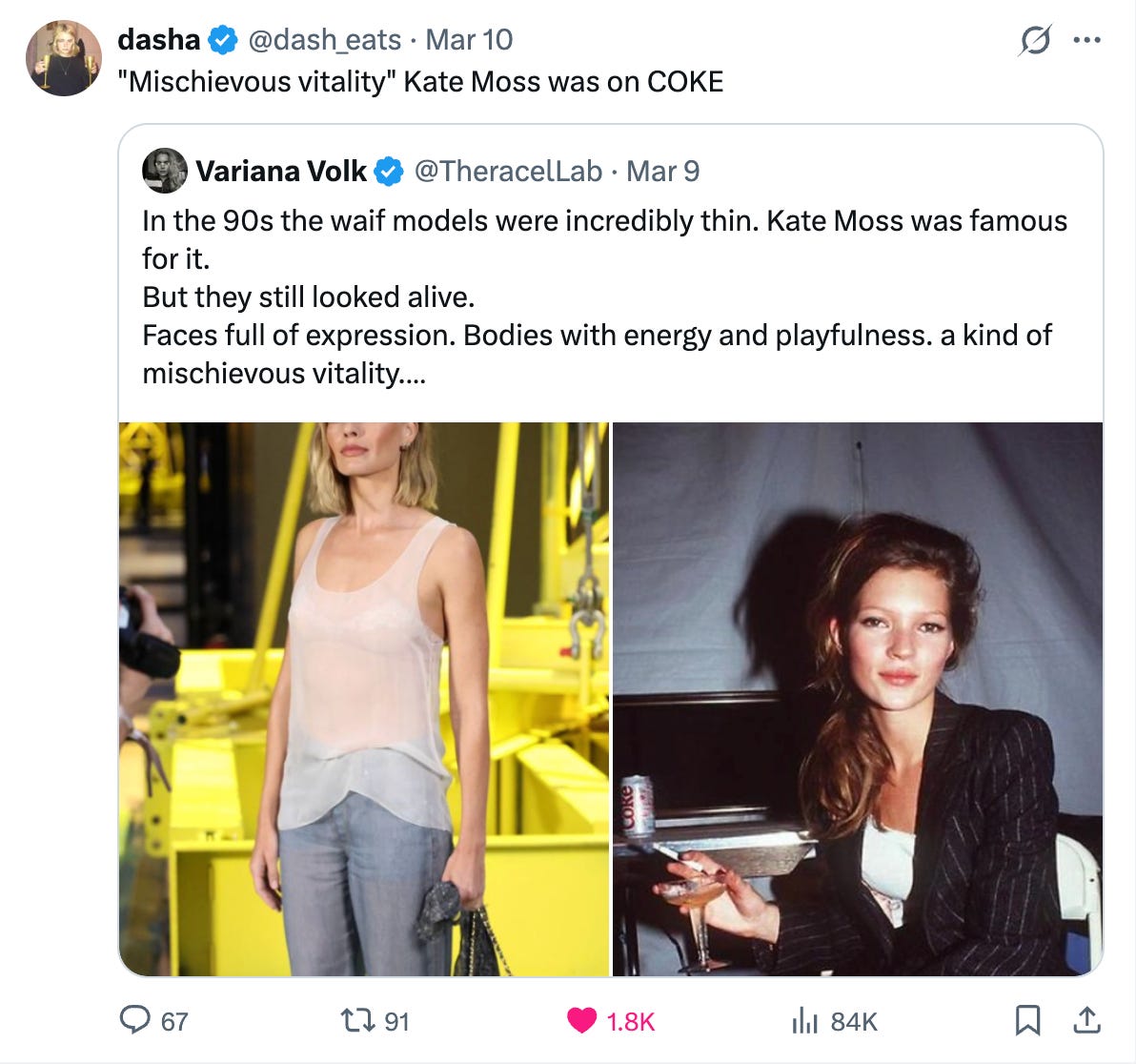
The women who animated Tom Ford’s runways and campaigns were not ingenues, but they weren’t harlots either. They were something stranger and much harder to manufacture: playful and accessible, but also deviously angelic. Their faces looked luminous and almost innocent, but not quite. “Come hither” eyebrows cocked, crooked little smiles, hair that suggested they had slept in it or run their fingers through it as a compulsive behavior rather than a grooming one. Their beauty didn’t read as effortful or optimized. It just… was?
There was a kind of unfussy decadence to the whole thing. The thinness of the era—haute cokehead—wasn’t sculpted in a pilates studio or achieved through cramming protein into places where protein does not belong. It was a little reckless, the physical manifestation of a life that was happening faster than the body could keep up with. Even if they were trying, these models didn’t look maintained. They looked lucky.
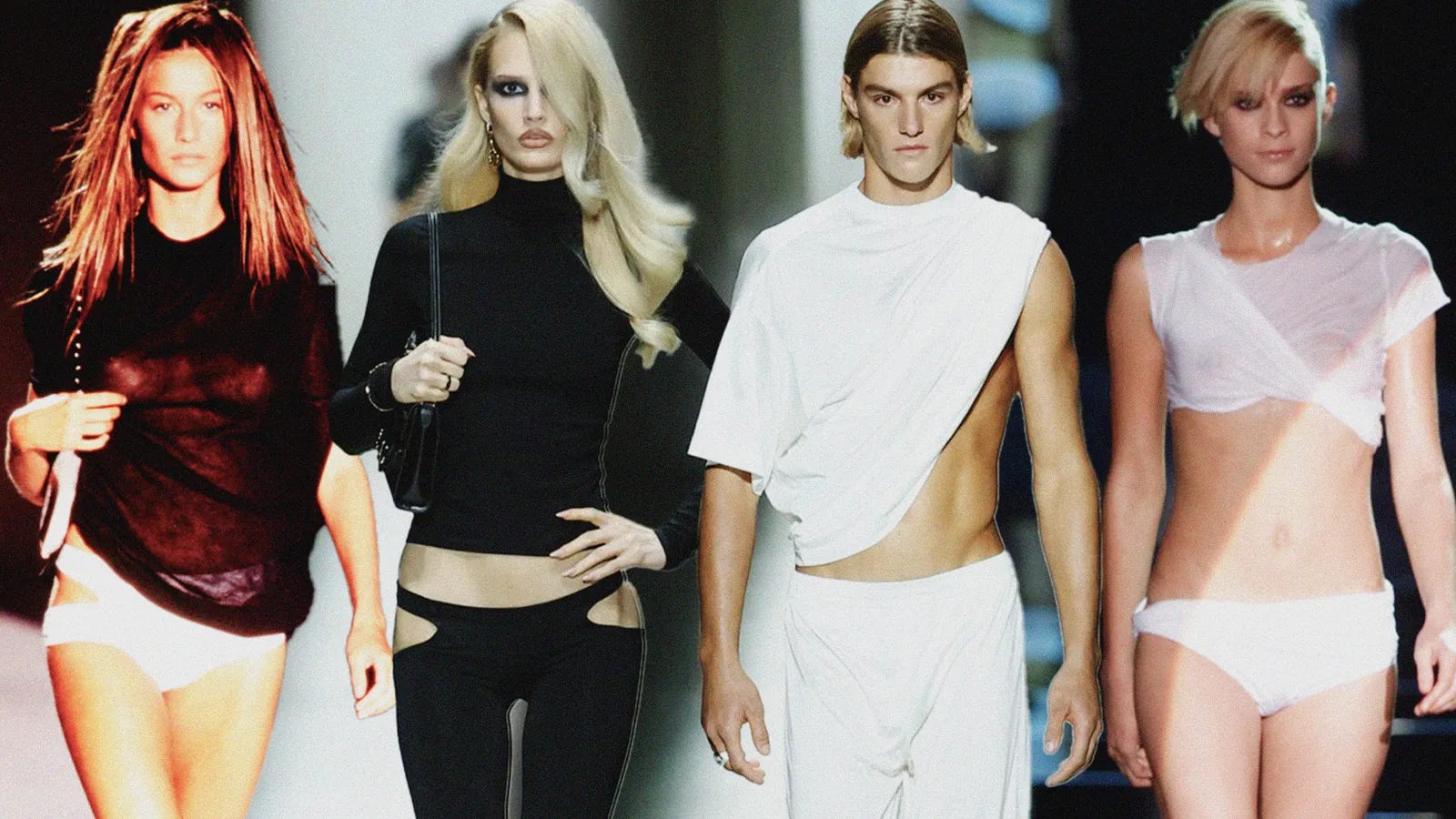
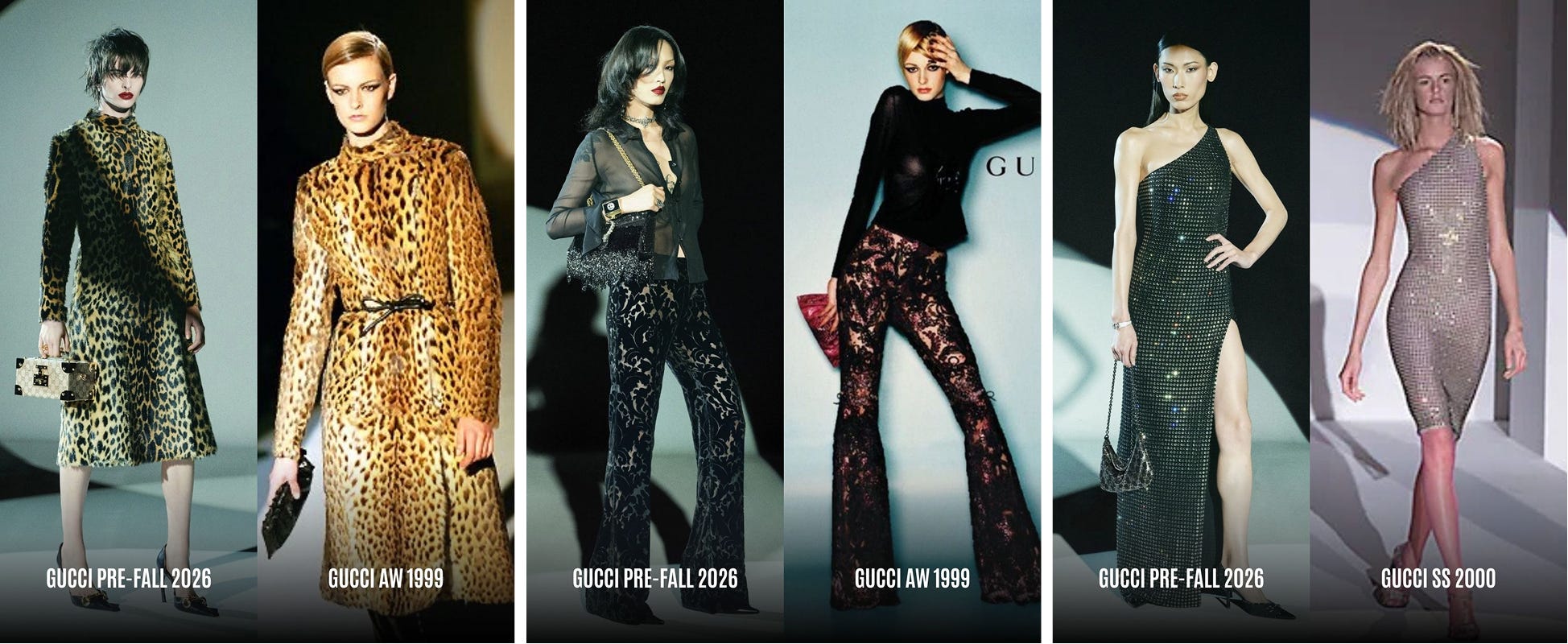
When compared with Demna’s homage, the difference becomes difficult to ignore. The silhouettes are identical: the same column silhouettes, the same glossy but undone hair, the same minimal styling that once made Tom Ford’s Gucci feel so dangerously decadent. But the faces belong to a different cultural moment entirely. Lips are fuller, cheekbones sharper, skin more polished, more controlled. The bodies look trained rather than incidental; everything appears meticulously maintained.
This is not a moral judgment. The modern face is beautiful and artful in its own way: symmetrical, luminous, scientifically precise. In this though, it reads differently. It doesn’t suggest the messy vitality of someone who has simply stumbled into beauty. It suggests someone who has worked, quite carefully, to achieve it. Pilates and buccal fat surgeries are probably less detrimental in the long-term than a habitual coke habit and old school anorexia, but don’t inspire the same kind of muse. It’s a difference that changes the entire mood of the clothes.
“Accidental beauty” was the look of the nineties. It was a culture in which—not yet subject to the panopticon of constant connectivity—people had no impetus to treat their bodies, their faces, and their identities as ongoing aesthetic projects. Today, both the West Elm girl and the Cigarette girl understand themselves as something to be curated. One optimizes while the other performs anti-optimization. But both are, in their own way, managing the self. An aesthetic built on accidental beauty can’t exist in a culture where “the self” has become a project under constant renovation.
This might explain why fashion can’t seem to leave the 1990s alone. We keep circling the era like it’s the last cultural moment that still makes sense to us. Designers resurrect its silhouettes, its hair, its blasé indulgence. The internet devotionally reposts old runway clips and paparazzi photos. Everyone agrees something about that period looked better, sexier, more free, even if it’s not possible to articulate why.
Culture is stuck. Instead of creating new archetypes, we recycle old ones. Not in a fun or interesting way, either: in a way that’s derivative and uninspired for the most part. It’s easy to hold a nostalgic fondness for the nineties, it was the last chance to live freely before the internet replaced every facet of socialization and consumption. They sit right at the edge of the “terminally online” epoch: modern enough to feel familiar, but just far enough away from algorithmic self-consciousness. Fashion keeps trying to resurrect that moment, but resurrection is not the same thing as revival.
We can, and should, bring back the clothes. I love a slip dress, I’ve actually been looking for the perfect one. (If you have any recommendations, please let me know.) The slick hair is timeless in a very specific way, the narrow silhouettes always en vogue. You can recreate the choreography of decadence down to the last detail, and doing so is fun.
However, it will always look just a little “off” because the women who once made those clothes look inevitable belonged to a culture that no longer exists. The sparkly silver slip that Em Rata wore on Demna’s runway would look so good on both The West Elm girl and the Cigarette girl. The West Elm girl would style it with an expensive blowout, a tiny shoulder bag, and a chic heel. She would look elegant, polished, exactly like someone who has more interests than just managing the perfect Notion board.
The Cigarette girl would wear the same dress differently. Maybe with a leather jacket thrown over it, eyeliner smudged just slightly, Marlboro dangling from her fingers as she stands on some dirty LES corner pretending not to care how good she looks.
Then they’d post a picture on Instagram. I would double-tap both, for the record, but they’d never make me feel the way any photo of Kate Moss does.
I love this take. I think about what it was like to come of age in the 90s, clothes can’t bring back the vibe that went with that time. We didn’t contour our faces, heavy grunge and hip-hop/rap influences played into everything. My friend and I remarked how much kids look just like us back then, but they are not us, because we didn’t live our lives digitally. There was bo curating an online persona. We kinda just were…for good or bad, who we were.
Not performing is still a performance now