

Kill The Striver Within
"E.M. in Brooklyn"

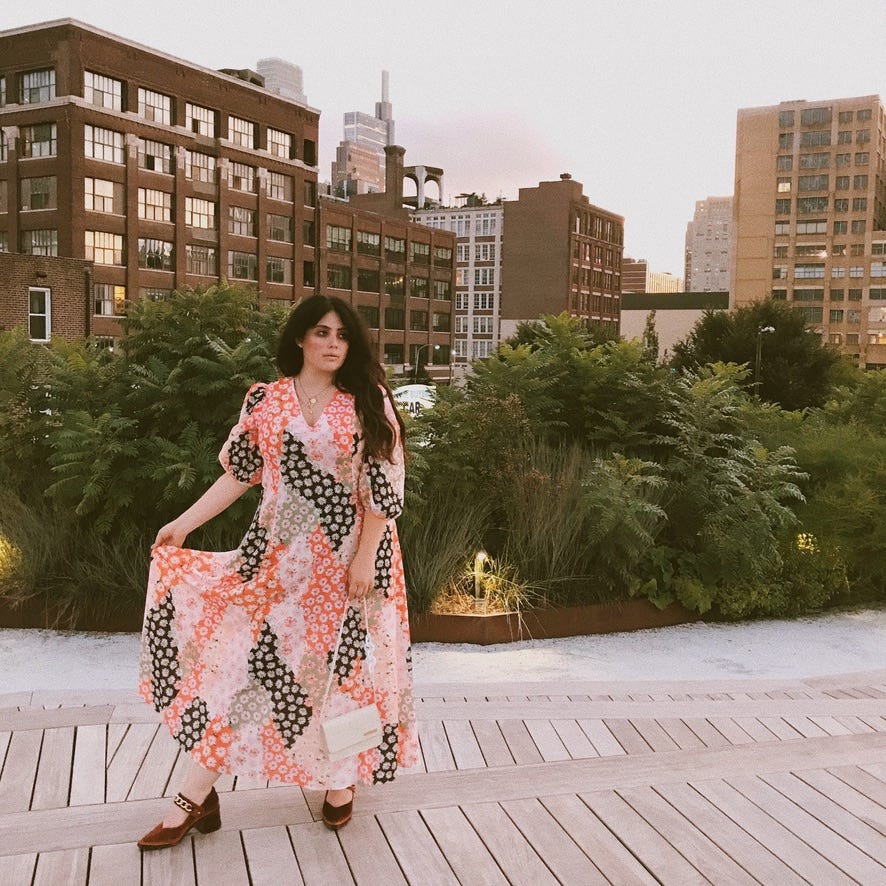
A week or so before I moved to Brooklyn, I went to an influencer event with my best friend. We got tipsy on “Spaghetts*,” then wandered over to the Rail Park to reminisce about my time in Philadelphia and take some #OOTDs. (You may now know them as “fit pics.”) I wore a horrendous patchwork print dress, petal pink lipstick that was very much not my season, my still-beloved orange velvet Reike Nen pumps (purchased secondhand from a closet sale hosted by the one and only Aimee Song), and a cream Jacquemus bag that I’d foolishly purchased before parting ways with the requisite $15K you must sacrifice to the broker gods in order to secure an apartment in New York City. (Yes, even Bedstuy.)
In hindsight, I wish we would have put our phones away, gotten a mediocre pizza, and sat in my living room watching The Jersey Shore.
When I think about my twenties, I’m not nostalgic for the days spent mural-hopping to secure the perfect shots of my outfits, the fake-friend photo ops I did with other influencers in the city (none of whom I particularly got along with anyway, all of whom hate me now, btw), the disingenuous social climbing I made a lifestyle of, or the careerist misery of early mornings and late nights in the office spent trying to appease bosses who were going to lay me off anyway. I miss the long nights with friends I just met drinking wine and smoking cigarettes, observing passers-by and debating the most asinine topics. The time I bruised the bottoms of my feet because I tipsily ditched my green Manolos somewhere between Girard Street and my cute little falling apart rowhome on Norris. The late nights listening to couples argue about where they parked after leaving the Taqueria on the end of my block, thinking “I should text him.” I often wish I wouldn’t have wasted so much of my twenties doing the other things.
To be fair, while in the throes of dopamine-induced Instagram narcissism, I didn’t think that I was wasting any time at all—in fact, I was convinced that I was building something meaningful; that I could potentially gift my future family some kind of trendy-D2C-brand-paid-campaign generational wealth. The pure delusion of thinking I was as pretty as the Blonde Salad (you now know her as Chiara Ferragni) or as aspirational as a Girl Meets Glam (that’s Julia Berolzheimer for those who have not been online as long as I have) is something to behold.
The Striver doesn’t recognize herself as such. She calls it drive, taste, “planning seriously for her future.” To be fair again, “influencing” did unlock a lot of opportunities and experiences for me, but none aside from some lingering credit card debt have lasted into this current iteration of my life. I actually hadn’t stopped to think about my checkered striver past until my husband and I recently started watching Emily in Paris, a series I tried and failed to watch twice before because I found the titular Emily to be so nerve-gratingly, irritatingly, irresponsibly frustrating.
Fifteen minutes into my third attempt at getting through the pilot, I realized: she was me. Or rather, she was the worst parts of me.
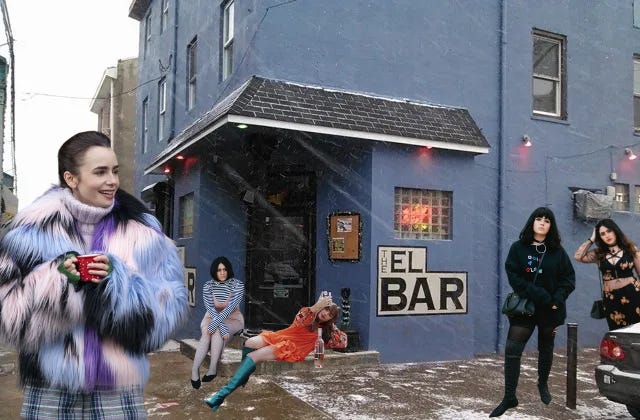
Watching the show feels like less of a guilty pleasure (I don’t believe in “hate watches,” we only have two episodes left in season five and I’m a little beside myself) and more of a postmortem of my twenties. The outfits—aside from Emily’s Rome arc which, admittedly, did have a few gems—are insultingly bad, but what makes them indefensible is the pure try-hard energy willing them to life. It is only painful to watch because I’ve been there myself. Every bright color, every platform heel, every carefully-curated “effortless” pattern mix is a neon pink flare with glittery purple smoke shot into the sky: “I’m here and in case you were wondering, yes I do matter.”
I didn’t wear that patchwork dress because I liked it; I wore it because I thought it would photograph well (it did not) and it looked like something that someone more self-assured than me would wear.


There’s something uniquely American about all of this. As women of a certain age, I can say a lot of us were taught to become brave little strivers before we even learned how to sit still. The notion that we must be something is as innate to us as breathing, eating, fucking. The problem with all the striving isn’t the ambition (which I think can be a good thing), but the utter displacement of it all. You can never just enjoy where you are, you have to be playing some grandiose game of 4D chess against yourself, rehearsing the person you would like to be instead of living as the person you already are. The striver lives in anticipation; she seldom enjoys her own life for the sake of it. Everything about the media we consume, the society we’re conditioned in, and the attached incentives all tell us that this is a good thing. I got a tech job and moved to Brooklyn because I thought it was what I had to do. I traded in my boho-inspired dresses and suede platforms for sensible Everlane basics and the same white Veja sneakers that every other girl shoving her way onto the L was wearing because it’s just what you did when you move to New York. It was a reinvention that felt mature, like an arrival or maybe even the natural order settling into itself. In hindsight, it was a different brand of “striving.” The striver is most dangerous when she deludes herself into believing she’s not trying too hard at all.
My New York illusion was shattered very shortly after I’d moved there. (Eight and a half months, to be precise.) The guy I moved there to impress dumped me, the job I’d pridefully attained put me on a PIP (in hindsight, that reflected more on poor management than on me), and then, a little thing called “the pandemic” happened. We are rarely gifted such heavy-handed revelations at all, let alone in such quick succession, so I figured that my streak of misfortune must have been some sort of divine providence. Like Emily at the end of season four when everything horrible and inopportune happened all at once, I was at an impasse. One afternoon in late April 2020, in my cozy albeit very small apartment, I looked over at my rack of colorful vintage dresses, Everlane flats too narrow for my feet, and realized that none of it was actually “me.” It was content, simple as. Quarantine granted those clothes a forced sabbatical, and hanging there without an audience, they looked limp and strangely lifeless, stripped of the virile beauty I’d once projected onto them.


Sans audience, the striver within me was without a modus operandi. No men to impress, no offices to stand out in, no performative bottomless mimosas to sip alongside my insufferable social-climbing frenemies. I was a woman lost. I did what any reputable striver would do at first, and I posted through it. I wore nip-slip-prone sundresses to lie on the couch and watch Seinfeld, I went on Etsy and purchased about a dozen of those stupid masks (which likely did nothing helpful) to match most of my outfits, I staged silly little “floor picnics” just to feel something, anything at all. If Emily ever found herself alone in her apartment, I imagine she would have done the same. A new lipstick, a new man somehow, a new storyline; anything to avoid the deafening silence of compulsory solitude. The Striver cannot survive quiet. She requires motion—histrionic, theatrical motion. That’s why I impulsively bought a 110-year old home in rural Southern West Virginia: the ultimate striver move. Social and career suicide? All but guaranteed. Risk of discomfort? Astonishingly high. But, before the novelty wore off and the absurdity of it all set in, it was content. West Virginia, however, is not a place that takes kindly to curation.
When Emily’s storyline had gotten stale, she had Rome. I had Beckley. She’d be able escape to picturesque “Solitano” if things were getting too chaotic in the Eternal City; I’d drive seven and a half hours back home because I missed and craved the chaos of it all. Where Rome rewards spectacle, Beckley rewards immersion. There are no soft filters to make life here aesthetic, no ironic distance to pose from Dollar General parking lots. No one is particularly interested in your résumé if they can create more interesting gossip about you instead. If you stick out, you stick out plainly and the small town hive mind’s response to you will be merciless. For a while, I felt fraudulent in ways both physical and metaphysical. My city girl restraint and mystique read as costume, and my studied nonchalance looked ridiculous against these mountains, older than time itself, none of which have any interest in being aestheticized or idealized. I was forced to reckon with the difference between visibility and value, and I no longer wanted to be visible; I wanted to blend in. But despite my best efforts to do so, and in the ultimate irony of it all, I simply could not. It was a rupture that Emily could gloss over with a new co-ord with matching gloves, a new marketing pitch, a new foreign man. I ran out of reinventions. I needed to be real for once in my life.
Real looked like figuring out who I was: the good, the bad, and the ugly. I kept the sensible heels and sent the more garish or attention-begging ones to Goodwill for some other young striver to enjoy (as she fantasizes about life in a studio apartment in New York City, no doubt). I abandoned clothing with too much melodrama but kept a few pieces that invite speculation or projection, but no longer let my clothes do my talking for me. Instead, I read a lot of books and developed a personal philosophy and sense of self. I learned that it’s okay to piecemeal a worldview; in fact, all the strongest ones are formed like this. I became a stalwart force against aesthetics and beliefs easily summarized in a sentence or slogan, and a foremost skeptic of trends. A lot of people stopped fucking with me. It’s okay, I’m told it’s called “thinning the herd” or “addition by subtraction.”
Make no mistake: this is not enlightenment. I am still in a near-constant state of existential recalibration. I still want things, some things I want more than ever now that I’m a mom and realizing the stakes are that much higher. I still compare myself to anyone and everyone, younger versions of myself included. I still feel the old itch to compete when someone else ascends. I haven’t killed the Striver within so much as nearly suffocated her with a pillow for long enough to quiet her before putting her in the basement with a few bottles of water and protein bars. She thrives in my private Pinterest boards, my Instagram explore page, and in flashes of brilliance here and there in my vacation wardrobe. The patchwork dress is long gone, but the girl who wore it—for better or worse—is still here.
xo, e.m.
*Worst name for a cocktail by the way, I really hate it.
As cringey as that decade can feel in retrospect, there is something precious about the daringness of it all. Whether we were influencers or not, strive runs hard in those years. Art is created.
As the veil begins to fall in our fourth decade, we can begin return to ourselves. It’s like a rite of passage.
P.s. love that you shared those pictures. They’re fantastic.